
Maritime container transport resilient to geopolitical storms. Maersk with $15.8 billion in sales in Q2 2026
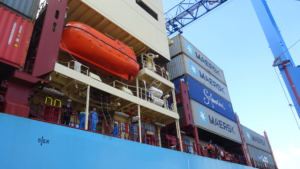 Photo: Marek Grzybowski
 By
Containers are driving ocean business and delivering extraordinary profits. Geopolitical storms, the blockade of ships in the Persian Gulf, extended liner services, and port congestion have not derailed maritime container transport. On the contrary, shipowners and fleet operators took advantage of these extraordinary circumstances to strengthen their business in the second quarter of 2026.
Maersk is a prime example of excellent market insight and management flexibility in operating services and vessels in the dynamically changing maritime transport market. A.P. Møller – Mærsk A/S (APMM) recorded a 20% year-on-year increase in revenue to $15.8 billion in the second quarter of 2026, achieving EBITDA of $3 billion and EBIT of $1.6 billion. Møller – Mærsk has revised its full-year forecasts upwards, the Management Board announced in a commentary to the “A.P. Møller – Mærsk A/S Q2 2026 Investor Presentation.”
The strong growth in service revenue in the second quarter of 2026 was driven by higher spot rates in maritime transport and higher container volumes. Based on market analysis, the Copenhagen-based operator is revising its sales and profit forecasts. The new sales and profit forecasts are based on stable demand and persistent bottlenecks in global supply chains. An important basis for the revisions is the structural changes in freight and logistics prices accepted by customers.
“Considering the increase in market volumes of approximately 4%, we currently forecast operating profit before interest and tax (EBIT) of USD 4.5-6.5 billion and positive free cash flow,” commented Vincent Clerc, CEO, A.P. Møller – Mærsk A/S, in the investor presentation. Møller – Mærsk A/S (APMM), reports Yahoo Scout.
Higher profits also contributed to an increase in free cash flow, with cash flow reaching USD 549 million. This represents a significant increase compared to the previous year. Container maritime transport performed very well, with EBIT significantly higher year-on-year and returning to positive territory. The increase in container supply was supported by strong market demand. The market here was clearly driven by the active economies in the Far East.

Maersk Financial Results. Source: “A.P. Møller – Mærsk A/S Q2 2026 Investor Presentation”
Spot and Vietnamese Investments
Spot rates drove profits, while high costs related to the situation in the Middle East were offset by commercial activities. Logistics & Services also recorded strong revenue and EBIT growth. This is the ninth consecutive quarter of year-on-year growth, with an EBIT margin increase.
The container terminals division also continued to achieve strong profits, APMM reports in its quarterly report, explaining that economic performance was “supported by higher freight revenues and disciplined cost control, while progress was made on growth investments in existing and new locations.”

Maersk Investments in the Hai Phong Terminal. Source: “A.P. Møller – Mærsk A/S Q2 2026 Investor Presentation”
It is worth highlighting APMM’s active involvement in building a logistics network. The operator recently secured a 50-year concession to build a new multi-user facility encompassing the entire port of Da Nang. The port is surrounded by an economic zone and operates in a region with high export growth potential. The concession was awarded to the consortium through a competitive tender.
It builds on the successful partnership between A.P. Møller – Mærsk A/S and Hateco, which was successfully implemented at the Hai Phong terminal (opened in 2025). The concession envisages the development of eight deep-water quays with a total capacity of over 5.7 million TEU per year. The port is ideally located in the region and serves central Vietnam. It is considered a gateway to Laos, Cambodia, Thailand, and Myanmar. APMM announces that “Phase 1 (berths 1 and 2) will be launched in 2029.”
Ocean and the US Fleet
APMM’s driving force is its ocean transport division – Ocean. The Danish shipowner achieved strong results in the second quarter of this year by flexibly managing its fleet. “Looking at the key operational data across segments, in the Ocean division, we leveraged the flexibility of our network and implemented the necessary operational changes to adapt to the new situation in the Middle East, and we also successfully increased volumes in other corridors,” Vincent Clerc explained to investors.
It is worth noting that Maersk Line Limited has the largest fleet of vessels flying the US flag. It comprises 20 medium-sized vessels (K-class 6,400 TEU) and large Madrid-class containerships (20,568 TEU). They cover approximately 1.7 million nautical miles annually, which, according to Maersk, equates to 72 circumnavigations of the globe. Operators have introduced over 3.13 million conventional containers and over 365,000 reefer containers into this market.

Maersk’s US activity. Source: Maersk
The strong results in Q2 2026 were driven by weekly volumes currently consistently above pre-war levels. “As we indicated in the previous quarter, in March we successfully implemented commercial measures to offset the high costs related to the situation in the Middle East in contracts and also in our spot business,” said Vincent Clerc. At the same time, the Danish shipowner benefited from the fact that “continued strong market demand and more unbalanced trade flows led to increased congestion in many geographic regions. This triggered another wave of spot rate increases from mid-May.”
Strong Balance Sheet
Robert Erni, Maersk’s CFO, reports on how the market situation was exploited. “Our balance sheet remains strong, with $18.5 billion in cash and deposits and $1.5 billion in net cash,” Robert Erni informed investors. Improved shipping and terminal performance also translated into improved cash generation in the second quarter of this year.
Operating cash flow reached $2.3 billion, supported by EBITDA of $3 billion. “Compared to EBITDA, this represents a cash conversion of 75%,” explains Robert Erni, as “the lower cash conversion compared to the previous quarter was mainly due to increased working capital, reflecting higher receivables following the rate increase.” freight and higher bunker prices.
Taking advantage of the strong economic results, APMM invested calmly. Gross capital expenditures amounted to USD 931 million, which was planned for this year. Lease repayments amounted to USD 863 million. “After all this, free cash flow was positive and better than both the previous quarter and the same period last year,” Maersk’s CFO boasted about the results.
Summarizing the results, Maersk points out that Q2 was positive because “the ocean segment contributed the most to this growth, increasing revenue by USD 2 billion, while the Logistics and Services and Terminals segments reached USD 554 million and USD 141 million, respectively. EBITDA increased from USD 2.3 billion to USD 3 billion, and EBIT from USD 845 million to USD 1.6 billion. These divisions also performed well, mainly due to the improved results in the ocean segment. – EBIT margin was 10%, improving by 3.6% year-on-year and 7.4% compared to 2.6% in Q1 2026.

Maersk Terminals’ Economic Results. Source: “A.P. Møller – Mærsk A/S Q2 2026 Investor Presentation”
Shipping with Risk
Ocean shipping remains risky, and the threat of terrorist attacks has significantly reduced traffic through the Suez Canal. “We currently transit the canal in both directions every week, and in both directions, we are operating at about one-third of the volume or one-third of the services that would normally transit the canal,” explains Vincent Clerc, CEO of Maersk, in response to a question from analyst Parash Jain.
Maersk assumes this is a prelude to a gradual, full return of services through the Suez Canal. “All the analyses we are conducting, and all the military and intelligence stakeholders we are speaking with, have told us that, as is currently the case, the conditions for a full return through the Red Sea are met, and that is why we are providing these services,” emphasizes the Maersk CEO, noting: “We do not compromise on the safety of our crew, the safety of our vessels, or the cargo of our customers.”
Container ocean freight was the workhorse of the entire corporation. The Ocean division “achieved a strong financial result, supported by strong commercial and operational execution, with revenue up 23% thanks to higher freight rates and volumes.” Lower depreciation and amortization contributed to an increase in EBIT from $229 million to $935 million. EBIT margin increased from 2.7% to 8.9%.

A.P. Møller – Mærsk A/S (Maersk-A.CO) share price. Source: Yahoo Finance
Freight up 22%
These financial results were achieved thanks to average freight rates increasing by 22% and cargo volumes increasing by 4.1%. “Despite a 19% increase in operating costs due to higher fuel prices, the unit cost of constant energy decreased by 0.8% as higher volumes offset the increase in operating costs,” explains APMM. Excellent vessel utilization also contributed to the strong revenue. In the second quarter of this year, it remained at a high level of 96% (94%).
The Logistics and Services division also recorded another quarter of improvement. “With revenues increasing by 15% year-on-year and 11% quarter-on-quarter, the growth was led by land services, supported by Landbridge solutions connecting ports in the Persian Gulf region,” APMM reports. Freight forwarding benefited from strong volume growth in aviation and project logistics.

Maersk Ocean Results. Source: “A.P. Møller – Mærsk A/S Q2 2026 Investor Presentation”
Operating profit before tax (EBIT) increased by 24% year-on-year, resulting in an EBIT margin of 5.1% (4.8%). A quarter-on-quarter increase of 0.5% was achieved. Terminals demonstrated high efficiency, offsetting losses incurred as a result of the conflict in the Middle East.
“Revenue [of the Terminals – MG division] increased by 11% to USD 1.4 billion (USD 1.3 billion), thanks to a 2.2% increase in volume and a 7.1% increase in revenue per shipment,” APMM reported in its Q2 2026 report. The higher revenue from services was achieved due to increased rates for terminal operations and higher warehousing revenues. As a result, “the EBITDA margin improved year-over-year, while the lower EBIT margin of 31.6% (35.3%) was primarily due to one-time items in 2025.”
Free cash flow of $549 million (negative $373 million in Q1 2025) increased due to a $347 million reduction in capital expenditures and a $395 million increase in operating cash flow. This was driven by the improved EBITDA. Cash distributions to shareholders during the quarter, including dividends and share buybacks, totaled $367 million.

U.S.-flagged Maersk fleet liner services Source: Maersk